
Agentic pipeline for LAMP stacks
Pete Panel clones a site into a disposable Docker copy with real WP-CLI, files, database and logs, so an AI agent can do the work with production out of the loop: clone, delegate, approve, ship. Ozone Group builds its own site, its three platforms and its client stores this way, and the same stack ships to any cloud you own with one installer.





a month is WP Engine’s biggest published plan, for 400,000 visits. Source: the plan comparison published on deploypete.com/benchmarks, where the same workload is measured on a server you own.
An agent cannot work on production, and a sealed environment is not a workshop.
Ozone Group builds on LAMP: WordPress and WooCommerce, PHP and Laravel, MySQL, on Ubuntu. Delegating that work to an AI agent breaks on two walls. A senior developer never points an agent at a live store, and the local tools that could host the work are owned by hosting companies: sealed environments, no real shell, and an export button that points at their servers. Managed WordPress then charges by visits, so the bill grows with the traffic the work creates.
The brief was a pipeline of our own: give the agent a disposable copy of any LAMP site with the same WP-CLI, files, database and logs a developer would touch, keep production out of the loop until a human approves, and ship the result to a server the client owns. That pipeline is Pete Panel, and ozonegroup.co is built on it.
A week of work delegated in an afternoon, on a bill that does not grow with traffic.
An 8 GB RAM, 4 CPU Linode at $48 a month serves 216 to 432 million cached visits a month and 5,000 to 10,000 concurrent users, at an average page load of 0.3 to 0.5 seconds. Published on deploypete.com/benchmarks and validated with a k6 load test against a Pete Panel server.
Four steps, and the stack that carries them.
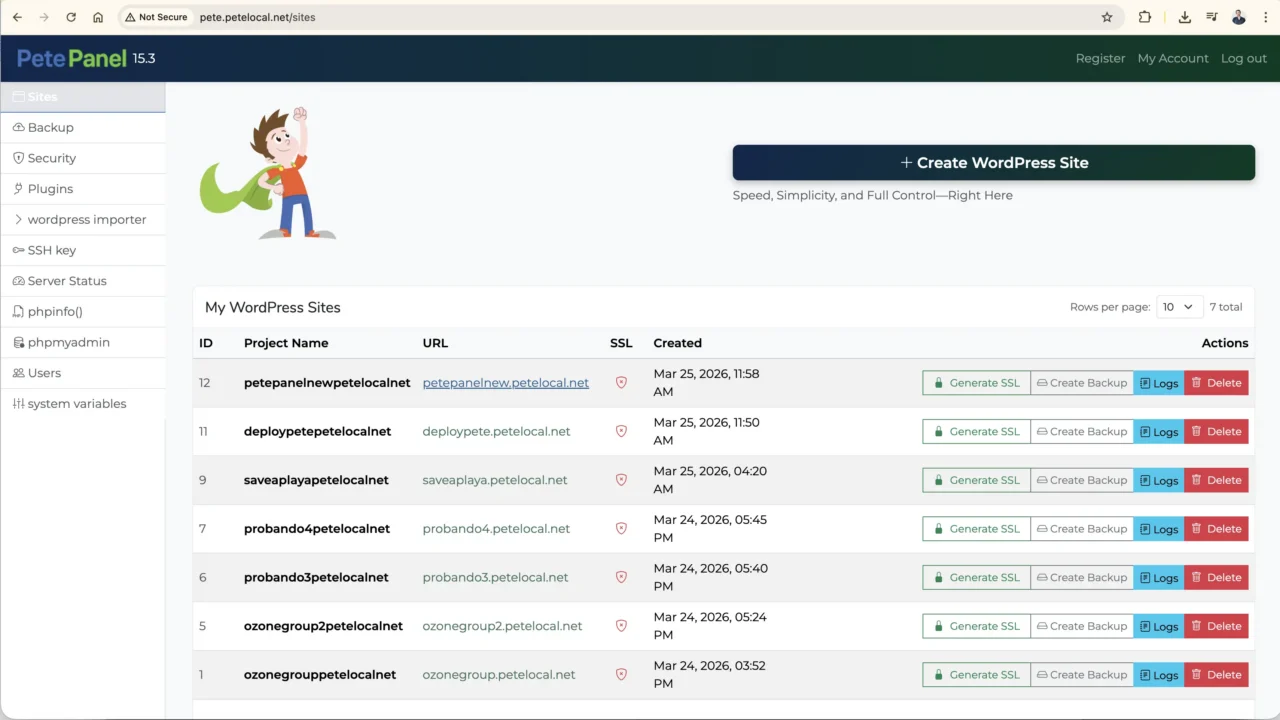
Pete Panel is a Docker-based hosting and deployment platform: a disposable playground on your Mac for the work, and one installer for the server that runs it afterwards. The agent works in the playground, a senior engineer reviews, you approve, and one command ships.
Clone
Any LAMP site becomes a disposable Docker copy in minutes: WordPress and WooCommerce, PHP and Laravel, MySQL, on Ubuntu. Production is never in the loop, and a copy you break is a copy you delete.
Delegate
The agent gets what a developer gets: real WP-CLI, the file system, the database and the logs. Custom plugins, theme work, new landing pages, security audits, all inside the sandbox.
Approve
Nothing reaches the live site on the agent's say-so. A senior engineer reviews the diff against the brief, and you sign off on design direction, rights and anything that cannot be undone.
Ship
The first deploy exports in Pete format; after that, updates go one page at a time over SSH, backed up before the write and verified after it. The same environment from laptop to production.
One installer, any cloud
The same stack comes up on Linode, Hetzner, Google Cloud, AWS or any Ubuntu server you own. No lock-in and no reseller markup: you pay cloud prices for the machine.
Tuned for speed and locked down
Redis, OPcache, ModSecurity and free SSL, auto-tuned to the server, so the pages the agent builds arrive fast and the site it builds them on stays up.
Hire the developer, and the platforms come with an open license.
Pete Panel is free to start with one local site, and Pro brings your own site into it. The pipeline on this page is what a dedicated Ozone developer runs on top of it, on your stack, on US time.
The platform core with its updates, and every customization made for your account, kept running on our server or yours. Hosting and support included. No development hours; when you need them, $60 an hour. Month to month.
Both seats: one month minimum, paid in advance via PayPal or Payoneer, no recruiting fees, cancel any time after the first month.
Your site is cloned and the first task is delegated in week one.
Your developer operates as an extension of your team, taking briefs on Slack or a ticket. Production stays out of the loop the whole time: the agent works in a copy, a senior engineer reviews the diff, and the change reaches the live site only after you approve it.
Week one
Pete Panel goes up on your Mac and your site is cloned into a disposable Docker copy: the same WP-CLI, files, database and logs a developer would touch, with production out of the loop. Your developer sets the brief in Slack or a ticket, and the first task is delegated to the agent inside that copy the same week.
Week two
The loop settles: the agent drafts, your developer and the engineering lead in Orlando, FL review the diff against the brief, and you approve anything that cannot be undone. The first deploy exports in Pete format onto a server you own, with free SSL, Redis, OPcache and ModSecurity tuned to the machine.
Week three onward
Updates ship one page at a time over SSH, backed up before the write and verified after it, so a change goes out in minutes rather than a release window. From here the developer shapes the pipeline to your stack: a custom plugin, a Laravel service beside the store, a security audit, or the landing page your team asked for that morning.
FAQs
A Docker-based hosting and deployment platform built by Ozone: a disposable copy of any LAMP site on your Mac for the work, and one installer for the server that runs it afterwards. It is the pipeline behind ozonegroup.co, its three platforms and the client stores Ozone builds. Free to start with one local site; Pro brings your own site into it. See deploypete.com.
In the agentic era, the industry average is the floor.
E-commerce companies need a solution tailored to their own store to get ahead of the industry’s average metrics, not another tool with the same defaults as everyone else.
Part time from $2,500 a month (80 hours, one platform of your choice) or full time at $3,900 (160 hours, all three platforms), on US time, month to month, no recruiting fees.